
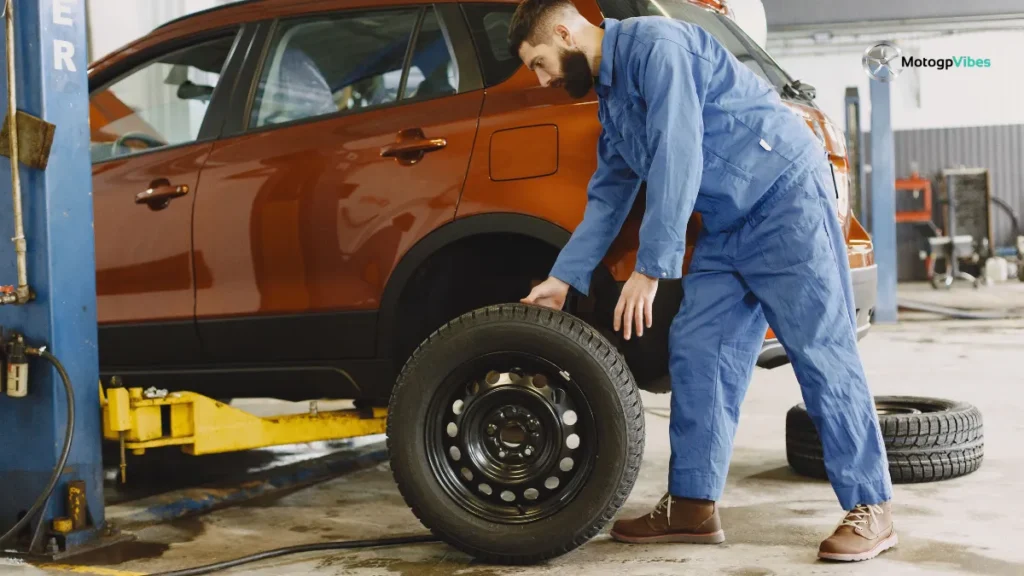
Tire rotation is necessary because front and rear wheels wear at different rates due to steering and braking pressure. If rotation is delayed, this gap widens — worsening handling, increasing fuel consumption, and shortening tire life. Experts recommend rotating every 8 to 10 thousand kilometers, or alongside an oil change. If the car pulls to one side or shows uneven tire wear, it’s time.
What Tire Rotation Actually Is
Tire rotation means changing the position of all four tires, for example, moving the rear tires to the front and vice versa, so all tires wear at roughly the same rate. Reasons this matters:
- Weight distribution: In most vehicles, the engine and transmission put more weight on the front axle.
- Drivetrain: Front-wheel-drive tires handle acceleration, braking, and steering, so they wear faster. In rear-wheel drive, that pressure shifts to the rear tires.
- Steering pressure: Front tires take more friction and side load during turns.
- Alignment: Camber and toe settings wear each tire’s edges differently.
Without rotation, one pair can wear out 30-50% faster than the other and need early replacement.
The Correct Interval
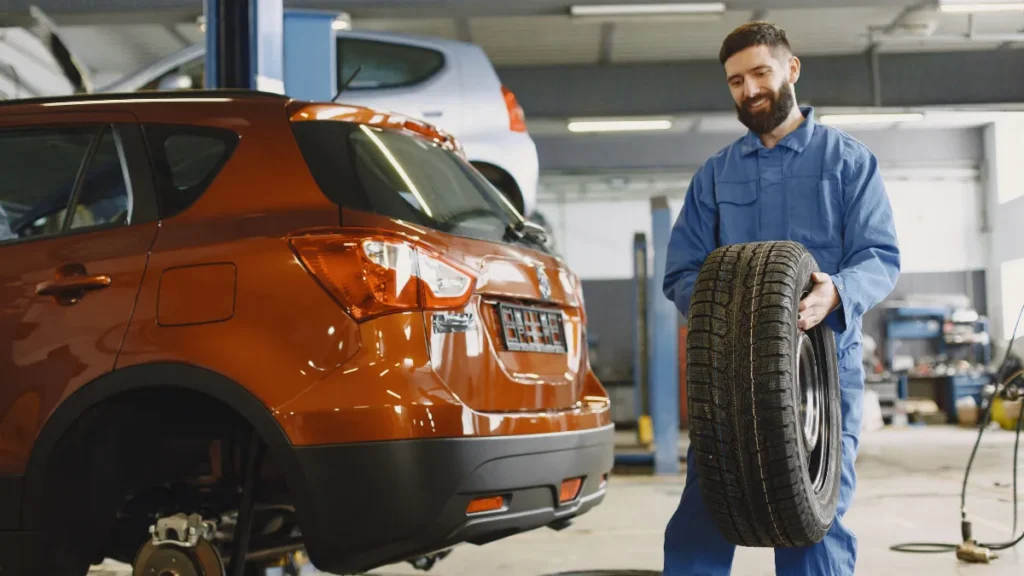
Generally, 8 to 13 thousand kilometers (5-8 thousand miles) is recommended:
- 8,000 km — where uneven wear typically starts becoming noticeable.
- 13,000 km — beyond this, the front-rear wear gap starts affecting handling and tire life.
This interval overlaps with oil changes because both typically cycle every 8- 12 thousand km, which is why “rotate with every oil change” became a practical convention, not a fixed rule.
Most reliable guide: Your vehicle’s owner’s manual; the manufacturer sets this figure based on your car’s specific weight distribution, suspension design, and tire type.
How Vehicle Type Changes the Pattern
Front-Wheel Drive (FWD): Forward Cross, front tires move straight back; rear tires cross to the opposite front side (rear-left → front-right, rear-right → front-left).
Rear-Wheel Drive (RWD) / 4WD: Rearward Cross, rear tires move straight forward; front tires cross to the opposite rear side.
All-Wheel Drive (AWD): X-Pattern, all four tires move diagonally to the opposite corner (front-left ↔ rear-right).
Directional or staggered tires: Can’t be crossed, only moved front-to-back on the same side, since tread direction is fixed or front/rear sizes differ.
The Biggest Misconception
Many assume the rotation interval is a fixed number for every vehicle and driver — but 8-13k km is just a baseline estimate. Real factors that shift it:
- Aggressive/jerky driving — more turns, faster wear → rotate closer to 8,000 km.
- Mostly highway driving — steady speed, fewer turns → can stretch toward 13,000 km.
- Low-profile/performance tires — wear faster and unevenly, so rotate more often.
- Uneven pressure or poor alignment — accelerates wear regardless of rotation schedule; rotation doesn’t fix alignment issues, it only slows their effect.
That’s why “rotate every 6 months” is misleading — six months of highway driving and six months of city driving don’t produce equal wear, even at the same mileage.
Real Warning Signs You’ve Gone Too Long
Ye raha short paragraph, points ke sath:
Here are some clear signs that it’s time for a tire rotation:
- Difference in tread depth: A difference of more than 2/32 inch between the front and rear tires.
- Cupping or wavy wear: A raised, wave-like mark on the tread.
- Feathering: One edge of the tread feels smooth, and the other feels sharp.
- Slight vibration on the highway: That wasn’t there before.
- The vehicle pulls to one side: Even on a straight road.
If these signs appear before 8,000 kilometers, it means that driving is causing more wear than average, and you should get your tires rotated immediately without waiting for the scheduled interval.
What Happens If You Skip Rotation
Mechanical consequences of not rotating tires, in points:
- Excessive wear on one axle: Those tires continue to bear the steering, braking, or driving force alone.
- Poor grip on wet roads: Low tread depth reduces the braking performance of the same axle.
- Unpredictable handling: The part with the most worn tires is more prone to skidding, especially in wet weather.
- Premature tire replacement: One pair reaches the legal limit (2/32 inch) earlier.
- Stress on the drivetrain in AWD: Different-sized tires put additional strain on the system.
A Practical, Reliable Rotation Schedule
Reliable tire rotation schedule, in points:
- Basic interval: Every 8 to 13 thousand kilometers or every other oil change (preferably the owner’s manual number).
- Tread depth check: Verify with a gauge or penny test at each rotation.
- Early rotation: Recommended for urban driving or low-profile tires.
- “Late rotation: Recommended for mostly highway driving.
- Correct pattern: According to the drivetrain (FWD, RWD, AWD or staggered).
- Alignment check: If there is uneven wear despite rotation, be sure to do it.
Conclusion
Most people consider tire rotation to be just a calendar reminder, while the reality is that one axle endures more steering, braking, or driving force than the other, which causes uneven wear. An interval of 8,000 to 13,000 kilometers is a good baseline, but if symptoms such as tread depth differences or vibration appear first, prioritize addressing them. It is equally important to use the right pattern for your drivetrain along with timely rotation—this combination of the right interval, the right pattern, and actual conditions is the real answer to tire rotation.
FAQs
Can I rotate my tires myself, or do I need a mechanic?
You can rotate your tires yourself at home with a jack and lug wrench, provided you follow the correct pattern. However, it is beneficial to have it done at a workshop because technicians usually check the alignment and tire pressure at the same time.
What happens if I skip tire rotation for too long?
Failure to rotate tires causes the tires on one axle to wear out much faster than the other, reducing their grip and tread depth. This makes the vehicle’s handling unbalanced, and instead of all four tires wearing out equally, only two tires have to be replaced prematurely.
Is tire rotation necessary for AWD vehicles?
Yes, tire rotation is much more important in AWD vehicles than in other drivetrains, because for their wheel speed sensors to work correctly, all four tires must have approximately the same tread depth; otherwise, uneven wear can put additional stress on the drivetrain itself.
Can skipping rotation void my tire warranty?
Often, yes. Most companies require proof of regular rotation to maintain the tire’s tread life warranty, and if the tire wears out prematurely due to failure to rotate, the warranty claim may be rejected.
Related Articles:
Don’t Replace Your Corolla Brake Pads Until You Read This
Jeep Wrangler Problems: Common Issues & Years to Avoid
Toyota Corolla Oil Change Interval: Every Owner’s Guide

Zarmeen Rafiq is an automotive writer at MotoGPVibes who covers car reviews, buying guides, vehicle comparisons, and automotive news. She creates clear, well-researched content to help readers make confident and informed decisions.